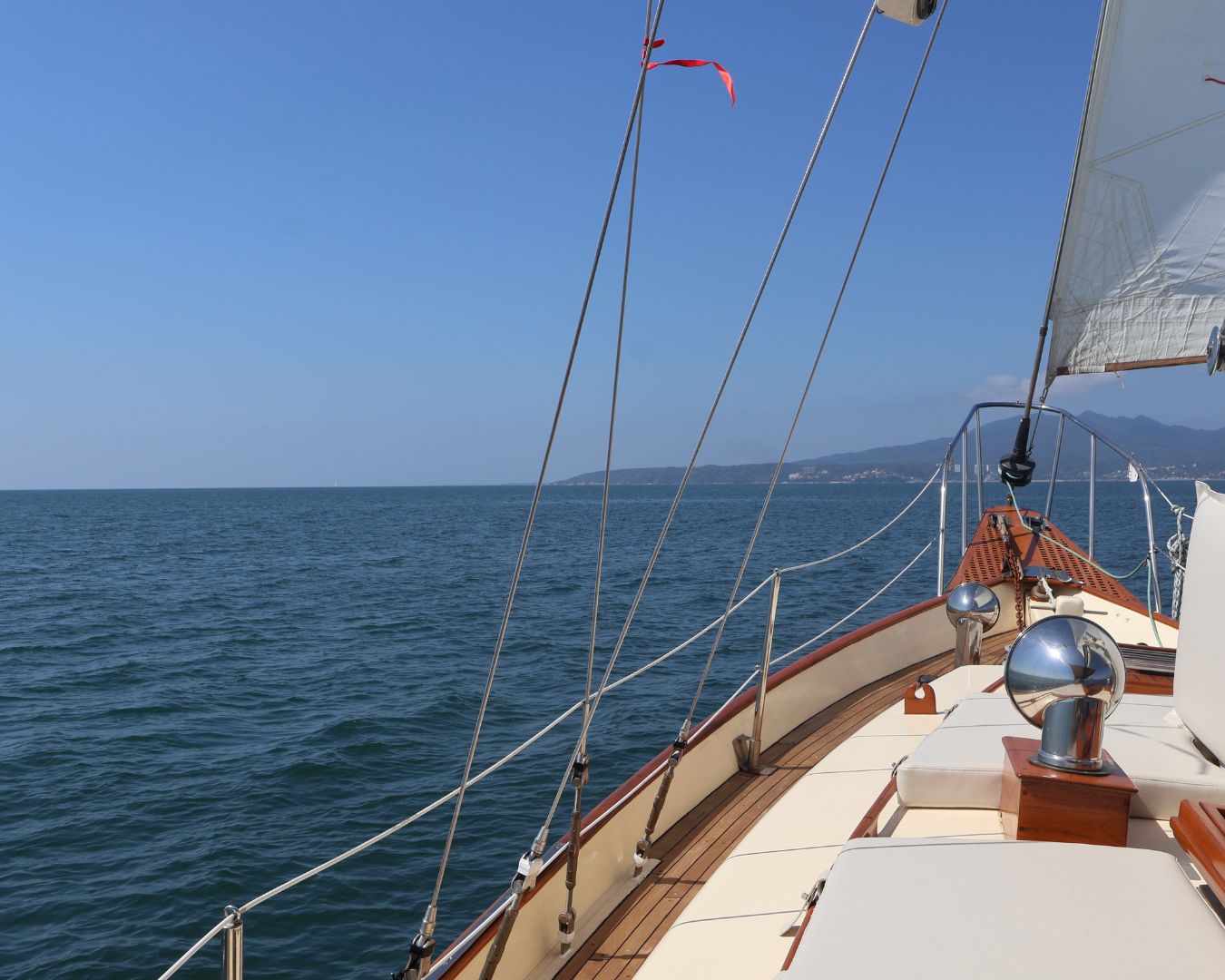
You’re sitting on a sailboat in Banderas Bay. The engine quiets, the crew raises the sails, and the boat keeps moving. If the wind isn’t even blowing directly behind you, how is that possible?
You don’t need a physics lesson to enjoy the answer. A sailboat moves because its sails turn wind into forward motion, while the part of the boat below the water helps keep it on course. Once you know what to look for, you can watch it happen from your seat.
Here’s a beginner’s guide to how sailing works and what you might notice on a sailing trip in Puerto Vallarta.

The short answer: wind, sails, and water work together
Imagine holding your hand out of a moving car window and tilting it slightly. The air presses against your hand and pushes it in a particular direction. A sail interacts with moving air too, though its curved shape makes the effect more useful than a flat sheet would.
Depending on the boat’s angle to the wind, air flowing around the sail and wind pressing against it create a force. Some of that force drives the boat forward; some pushes it sideways.
That’s where the underwater part comes in. The keel resists much of the sideways movement. The rudder helps steer. Together, they allow the boat to follow a course instead of simply drifting wherever the wind blows.
In brief:
- Sails turn wind into a driving force.
- The keel helps resist sideways movement and adds stability.
- The rudder helps the captain steer.
- The hull moves through the water as all those forces work together.
The exact way the sails produce force changes with the boat’s direction relative to the wind. The crew adjusts them as the course and conditions change.
Are sails just catching the wind?
Sometimes, that description is close enough. When the wind comes from behind, it pushes against the sails and helps move the boat along.
But a sailboat can also travel when the wind comes from the side or from an angle ahead. In those conditions, the sail is trimmed so air flows around its curved surface. The resulting force has a forward component, while the keel limits how far the boat slips sideways.
Think of the sail and keel as partners. The sail works in the air; the keel works in the water. Neither explains the whole journey on its own.
That also explains why a sailboat doesn’t always point in the same direction as the wind. Sailing is largely about choosing an angle where the boat can keep moving efficiently.
What does “trimming the sails” mean?
Trimming means adjusting how far a sail is pulled in or let out. When the captain changes course, or the wind shifts, the crew may adjust the sails to suit the new angle.
On board, you might see someone pull a line, ease it, or watch the edge of a sail.
They’re checking whether the sail has a useful shape and whether air is flowing across it smoothly.
A sail that flaps is easy to spot and hear. It may need an adjustment, or the boat may be pointing too close to the wind. A sail that fills and holds its shape is usually doing its job. Sail trim is an ongoing response to wind and course, even during a relaxed cruise.
Can a sailboat travel toward the wind?
Yes, but not directly into it.
Picture a destination upwind. The captain steers at an angle to the wind, travels for a while, then turns so the wind comes across the boat from the other side. Repeating those angled legs lets the boat make progress toward the destination.
That turn is called a tack. As the bow passes through the wind, the sails move to the other side of the boat. If you hear the crew preparing to tack, you may notice them handling the lines before the turn.
It can feel like taking a winding path toward a place you can already see. The route is longer than a straight line, but it allows the boat to keep sailing.
A few useful wind directions
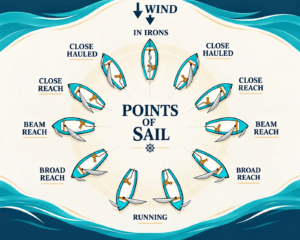
Sailors have names for the boat’s angle to the wind. You only need a handful to follow what’s happening:
- Into the wind: The boat cannot keep sailing straight toward the wind under sail alone.
- Close-hauled: The boat sails as close to the wind as it can effectively manage.
- Reaching: The wind comes more from the side.
- Running: The wind comes from behind.
Each direction calls for a different sail position. On one leg, the sails may be pulled in close. On another, they may be let farther out. If you’re curious during your trip, ask the crew where the wind is coming from. That one detail makes their adjustments much easier to understand.
Why does the boat lean?
When wind pushes on the sails, a sailboat may lean to one side. Sailors call that heeling. The keel and the boat’s design help counter that force, but a little lean can still be part of sailing.
For a first-time guest, it can feel surprising because the deck no longer seems level. Watch the crew: they’ll be paying attention to the wind, the boat’s movement, and the comfort of everyone aboard. If you feel unsure, tell them. They can explain what you’re feeling and help you find a comfortable place to sit.
You may also notice that the boat feels different after a tack. That’s because the wind is now coming from the opposite side, so the boat may lean the other way.

What does the captain actually do?
A sailboat doesn’t simply go wherever the wind takes it. The captain chooses a course, steers, and responds to the conditions. The crew helps manage the sails and keeps an eye on what’s happening around the boat.
Their decisions include:
- Which direction to take for the available wind.
- When to pull in or ease the sails.
- Whether to tack to reach a destination.
- When conditions call for a change of plan.
- When using the engine makes sense.
That last point often surprises new guests. A sailboat has an engine for practical reasons. It can help when leaving or entering a marina, or when there isn’t enough usable wind for the route. Seeing the engine used during part of a trip doesn’t mean the sails are decorative; it means the crew is navigating the conditions they have.
What will you notice while sailing in Puerto Vallarta?
Banderas Bay gives you room to take in both the coastline and the mechanics of sailing. On Ada, AdaSailing’s 45-foot classic sailboat, you can settle in and watch the crew work as the boat moves across the bay. AdaSailing offers private sailing trips as well as a small-group sunset experience.
Try paying attention to a few small moments:
When the sails fill
After an adjustment, a flapping sail may become smooth and full. You might feel the boat move more steadily soon afterward. It’s one of the clearest ways to connect what you see above you with what you feel beneath your feet.
When the boat changes direction
Look at the sails before and after a turn. How far are they from the center of the boat? Which side is the wind coming from now? You don’t have to remember the nautical terms to recognize the pattern.
When the engine quiets
With the engine off, you can hear water along the hull, air in the sails, and the crew making small adjustments. For many first-time guests, that’s when the question “How does this boat actually sail?” becomes especially interesting.
The experience will vary with the wind on the day. That’s part of what makes a sailboat trip feel different from following a fixed route on a powerboat.
Do you need to know how to sail before boarding?
Not at all. On a crewed trip, you can spend the whole time enjoying the view. You can also ask questions if the lines, sails, and turns catch your attention.
If you’d like to understand more while you’re aboard, start with these three:
- Where is the wind coming from?
- Why are the sails set this way?
- Are we sailing toward our destination or preparing to change course?
Those questions can turn a pleasant ride into a closer look at the decisions behind it. They also work during sunset sailing, when watching the sails and watching the light change are both good reasons to put your phone down for a while.

See how sailing feels for yourself
A sailboat moves by using the wind at a workable angle. Its sails create the driving force, its keel helps resist sideways movement, and its captain and crew adjust the course as conditions change. That’s the idea. The best way to understand it is to feel the boat move.
If a day of sailing Puerto Vallarta sounds like your kind of trip, explore AdaSailing’s sailing experiences or plan a sunset sail aboard Ada. Bring your questions—the crew can show you what’s happening as you go.