You’ve probably seen an anchor hanging from the bow of a sailboat and thought its job was pretty simple: throw it into the water, let it sink, and the boat stays put.
If only sailing were that easy.
An anchor is one of the most important pieces of safety equipment aboard a boat. And surprisingly, its ability to hold a boat in place has less to do with simply being heavy and much more to do with its shape, the seabed beneath it, the anchor rode, and how it is set.
That is also why anchors come in so many strange shapes.
Some look like claws. Others resemble farming equipment. Some have large triangular flukes, while modern designs look almost sculpted.
So, why are there so many types of boat anchors, and how do sailors decide which one to use?
Here’s the simple version.
What Does a Boat Anchor Actually Do?
One of the first misconceptions about anchoring is that the anchor holds the boat because of its weight.
Weight helps, but that isn’t the whole story.
Most recreational anchors are designed to penetrate or engage the seabed. As the boat pulls against the anchor rode—the chain, rope, or combination connecting the boat to the anchor—the anchor digs deeper and develops resistance.
Think of it less like placing a heavy object on the bottom and more like driving a wedge into the ground.
This is why seabed composition matters so much.
An anchor that performs beautifully in sand may struggle in vegetation or rock. Mud presents another challenge because it can be soft enough that an anchor needs considerable surface area and penetration to develop reliable holding power.
And that brings us to all those different shapes.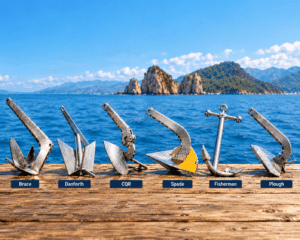
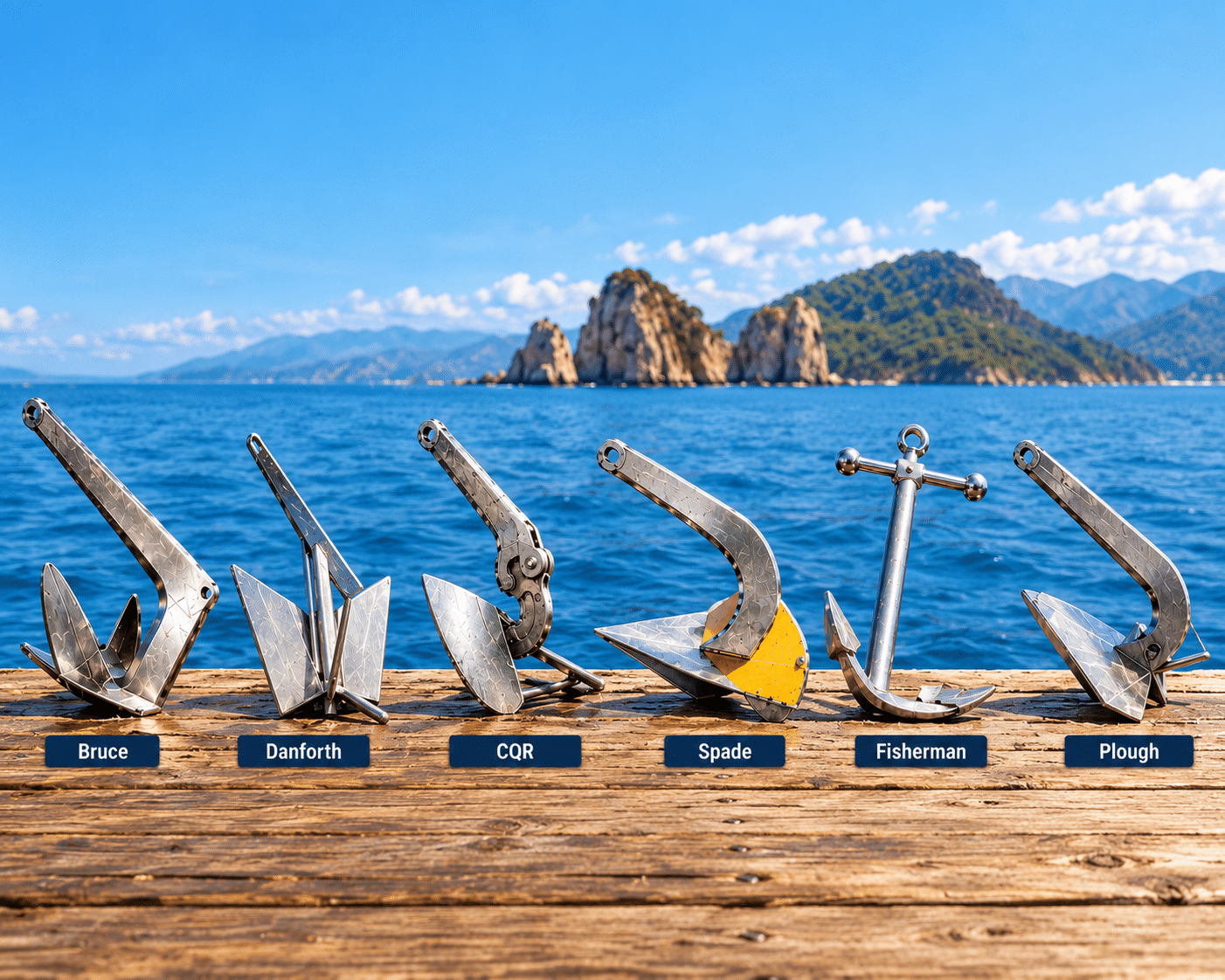
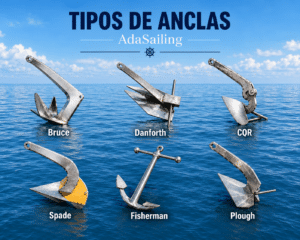
1. Bruce or Claw Anchor
The Bruce-style anchor is one of the easiest designs to recognize.
Its broad, three-pronged shape resembles a claw, which is why this entire category is commonly called claw anchors.
One of its strengths is versatility. Claw anchors can set relatively easily and work across several bottom conditions, making the design useful for general-purpose anchoring. They are also capable of resetting as a boat changes direction with the wind or current. West Marine
However, versatility doesn’t mean perfection.
Hard clay and dense vegetation can make penetration more difficult, and newer-generation anchors may outperform traditional claw designs under certain conditions.
For cruising sailors, though, the Bruce remains an instantly recognizable part of anchoring history.
2. Danforth Anchor
The Danforth anchor takes a very different approach.
Instead of a heavy claw or scoop, it uses two broad triangular flukes designed to penetrate the bottom.
Its greatest advantage is impressive holding power relative to its weight.
Danforth-style anchors are particularly effective in sand and mud, where their large flukes can bury themselves beneath the surface. They’re also relatively lightweight and can be stored flat, which is useful aboard boats where space matters.
There is a tradeoff.
Those wide flukes aren’t ideal everywhere. Rocky bottoms, vegetation, and hard clay can prevent the anchor from digging in correctly.
So when you see that distinctive flat, triangular shape, you’re looking at an anchor designed primarily to dig rather than simply weigh the boat down.
3. CQR Anchor
The CQR is a classic among cruising sailors.
It belongs to the family of plow anchors, and its shape gives away the idea behind its design.
Much like a plow cutting through soil, the anchor is designed to penetrate the seabed as the boat pulls against it.
The CQR also has a hinged shank, allowing the anchor to react as the direction of pull changes. It has traditionally been used across a variety of bottoms, including sand, mud and vegetation. West Marine
For decades, CQR anchors were a familiar sight on cruising sailboats.
Anchor technology has moved forward, however.
Modern scoop-style designs have increasingly replaced traditional CQRs as primary anchors on many cruising boats because newer designs can offer faster setting and stronger performance in certain bottoms.
That makes the CQR an interesting example of how sailing equipment continues to evolve.
4. Spade Anchor
Now we’re getting into a more modern generation of anchor design.
The Spade anchor uses a concave surface designed to penetrate and bury itself into the seabed.
The basic philosophy is straightforward: rather than relying heavily on weight, create a geometry that helps the anchor orient itself and develop strong holding power once buried.
Modern anchors such as Spade, Rocna, Mantus and Manson Supreme have performed strongly in comparative testing, particularly in sand and mixed bottom conditions.
For sailors, this represents an important shift.
Anchor design isn’t static.
Just as sails, navigation electronics and hull construction have evolved, anchoring technology has continued to improve.
5. Fisherman Anchor
Ask someone who doesn’t sail to draw an anchor, and there’s a good chance they’ll draw something resembling a Fisherman anchor.
It’s the traditional nautical anchor: a long shank, curved arms and a crosspiece near the top.
You’ll find versions of it everywhere—from maritime logos to tattoos.
Historically, this design relied on one of its pointed flukes catching or penetrating the bottom. Its geometry can make it useful around certain rocky or irregular seabeds, but compared with modern anchors it is bulky and inconvenient to store.
That’s one reason you’re far more likely to see its silhouette on a nautical T-shirt than hanging from the bow of a modern recreational sailboat.
Still, understanding it helps explain how anchor design evolved from relatively simple hooks into today’s specialized equipment.
6. Plow Anchors
Here’s where terminology can get confusing.
A plow anchor isn’t necessarily one specific model. It describes a broader family of anchors whose shape and action resemble a plow penetrating soil.
The CQR mentioned earlier is one example.
Other designs have taken the same general principle and modified the geometry, weight distribution and fluke shape.
Plow and scoop anchors have become particularly common aboard cruising sailboats because they can perform across different seabeds and can often reset when wind or current changes the direction of pull.
And that’s an important feature.
Because a boat at anchor doesn’t simply stay pointed in one direction all day.
So, Which Anchor Is Best?
This is where sailors give you the frustrating answer:
It depends.
But in this case, they’re right.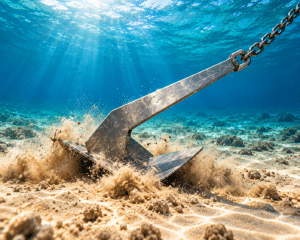
Choosing an anchor involves several variables:
- Boat size, displacement and windage
- Sand, mud, grass, rock or mixed seabed
- Expected wind and sea conditions
- Water depth
- Available storage
- Anchor rode configuration
- Whether you’re stopping for lunch or anchoring overnight
No single anchor design performs best under every possible condition. That’s why experienced boaters may carry more than one style aboard.
A Danforth-style anchor, for example, can be excellent in sand or mud, while a modern scoop or plow design may provide more versatility when bottom conditions change.
The right question isn’t simply:
“What’s the best anchor?”
It’s:
“What’s the right anchor for this boat, this bottom and these conditions?”
That’s a very different question.
The Anchor Is Only Part of the System. There’s another detail beginners often overlook.
A great anchor doesn’t automatically mean great anchoring.
The complete setup is called ground tackle, and it includes the anchor, chain or rope rode, connecting hardware and the equipment used to deploy and retrieve it.
Then there’s technique.
The crew needs to consider water depth, the amount of rode deployed, wind, current, swinging room and whether the anchor has actually set.
Simply dropping an anchor vertically beneath the boat isn’t enough.
Once deployed, the anchor needs the correct pulling angle to penetrate and remain buried. That’s one reason the amount of rode between the boat and anchor—known as scope—matters so much.
Anchoring, in other words, is a system.
And the shiny piece of metal at the end is only one part of it.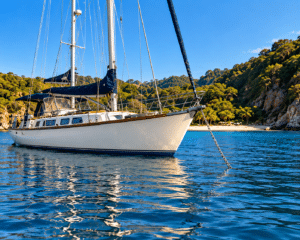
Why This Matters When You Go Sailing
You don’t need to memorize every anchor design before stepping aboard a sailboat.
But learning details like these changes the way you experience sailing.
Suddenly, that piece of equipment hanging from the bow isn’t just decoration.
You begin noticing what the crew is doing when approaching an anchorage. You understand why the captain may choose one area instead of another. And you realize how much planning goes into something that, from the outside, looks as simple as stopping the boat.
That’s one of the things we love about sailing.
There’s always another layer to discover.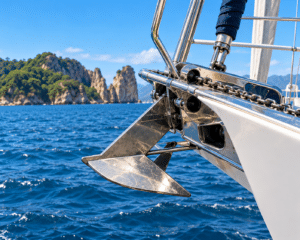
Learn Sailing by Experiencing It
The next time you see an anchor hanging from a bow, take a closer look.
Is it a claw? A plow? A modern scoop?
Its shape tells you something about what it was designed to do beneath the surface.
And while understanding the different types of boat anchors is a great introduction to seamanship, the best way to understand sailing is still to experience it from the deck.
At AdaSailing, we love sharing those small details that turn a boat ride into an actual sailing experience—from how the sails work to what happens when it’s time to drop anchor somewhere along the coast of Puerto Vallarta.
Because once you start understanding what the crew is doing, sailing becomes a lot more interesting.
Ready to experience it for yourself? Explore Puerto Vallarta from the water with AdaSailing.